A Tent on the Beach, a Peg in the Ground: Practising Solidarity in Portobello
A Tent on the Beach
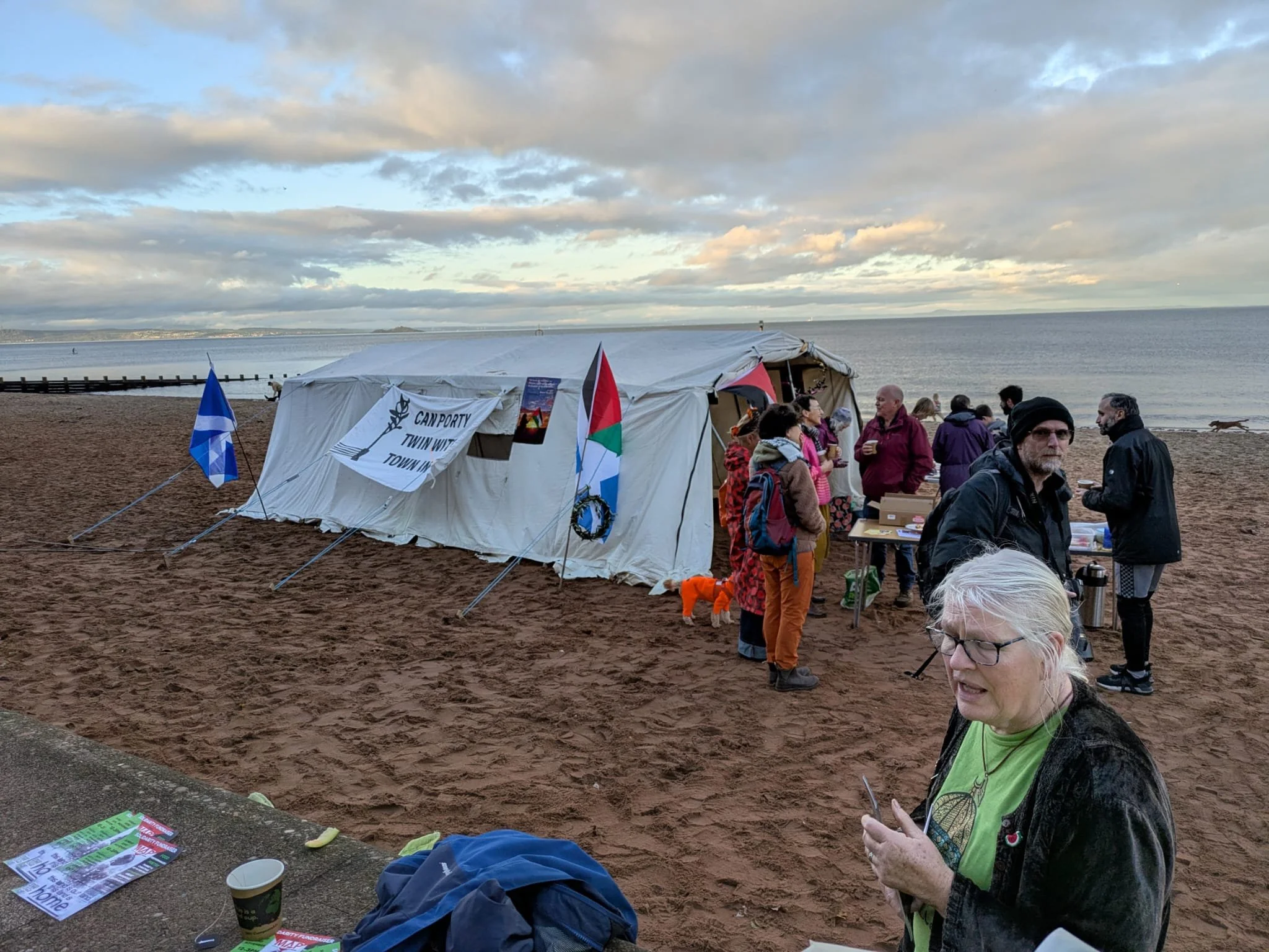
There is a photo of us standing by a tent on Portobello beach. The sea behind us, the wind doing what it always does, and a structure that looks almost ordinary until you realise what it represents.
That tent exists because we refused to be bystanders.
Porty Pals of Palestine grew out of a small group of us asking a simple but uncomfortable question: how do we respond, ethically and humanly, when a people are being destroyed in full view of the world? Protests and political actions mattered, and many of us were already involved in them. But we also felt something else was needed — something local, relational, sustained, and led by the people most affected.
We live by the sea in Portobello. Gaza is by the sea. That was the first thread we followed.
Practicing Solidarity in Portobello
We began exploring what “twinning” could mean when one community is living through mass displacement, erasure of place, and daily grief. We quickly understood that this could not be symbolic in a shallow way, and it could not be led by us alone. So we asked friends in Gaza what would be meaningful, what would help, what would honour their reality rather than soften it.
One answer came back clearly: be with us; let us lead; keep showing up.
And so we put up a tent.
Every couple of months, we raise a tent on the beach in Portobello. It takes time. It takes coordination. It takes people willing to be seen. The tent becomes a space for conversation, learning, quiet grief, shared tea, sometimes exhibitions or talks. We offer watermelon and mint tea. We listen. We talk. We send photos back to Gaza.
The first time we did this, I remember sitting down afterwards, exhausted, and realising that friends in Gaza had been watching us put the tent up in real time. Photos were being shared. Hearts appeared beside them. That small, almost absurd action — a tent on a Scottish beach — lifted hearts in a place where tents are symbols of unbearable loss.
That matters.
A Peg in the Ground
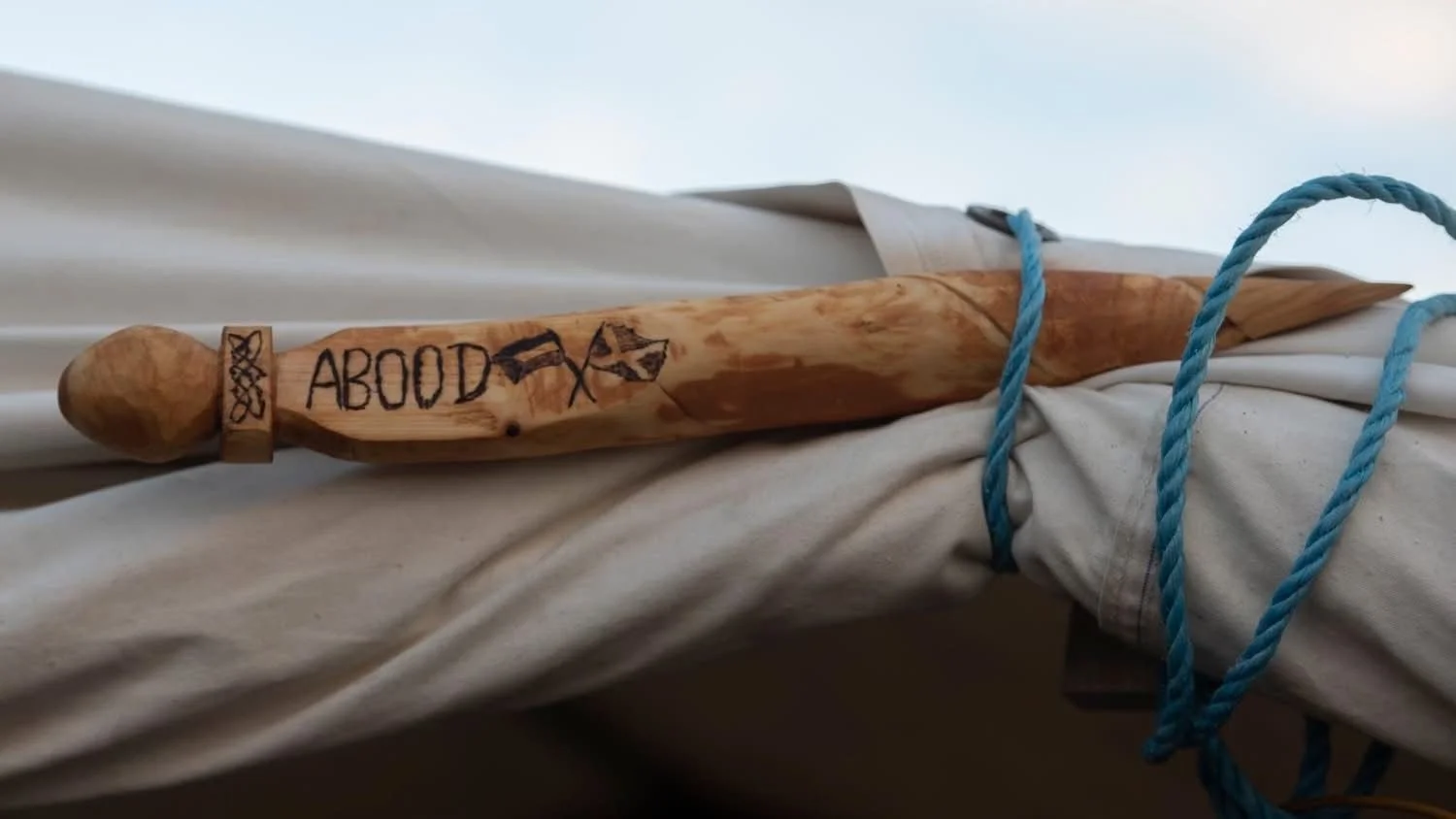
I am a craftivist. I believe deeply that making things with our hands can hold grief, memory, resistance, and care in ways that language alone cannot. Out of this work came something I did not expect to create: a Scottish–Palestinian Spiritual Tent Peg making tradition.
This particular peg is in honour of Abood, a Medical Aid for Palestine staff member who was killed when a minibus carrying MAP staff was destroyed in an attack in September 2025. Abood was a supervisor and close friend of one of my friends in Gaza. When I asked how I could support him in his grief, this was the response: make something that holds us to the ground.
A tent peg does exactly that. It anchors a fragile structure against wind and uncertainty. Each peg we make is an act of remembrance and a commitment to staying present. I now teach people across Britain how to make these pegs — slowly, intentionally, together. Each one is its own symbol and people are invited to keep and use the tent pegs they make in the knowledge that solidarity is not abstract. In June 2040 each person who makes a tent peg in this tradition is required to bring it to an exhibition we will hold on the beach by the tent. So we will all gather in physical solidarity then and renew our humanity.
This work is not easy. We share joy and ordinary life with our friends in Gaza, but we also witness unimaginable loss. There are days when all we can do is cry together. There are days when the political structures feel immovable, deaf, or frighteningly inert. And yet, again and again, people step forward asking: what can we do?
What I see emerging in Portobello is a form of community leadership that does not wait for permission. We are learning how to govern ourselves peacefully, thoughtfully, and with humility. We are practising discernment together. We are acting as a kind of cross‑cultural advisory board — listening, reflecting, responding, adjusting.
My role has often been to chair, to facilitate, to design gatherings that can hold complexity without collapsing into hostility or despair. This work draws on my experience in governance, advisory structures, and community development — but it also draws on something older and simpler: the belief that we belong to one another.
Ubuntu. I am because we are.
The call to action here is not a single event or campaign. It is an invitation into long‑term, peaceful, relational governance — rooted in dignity, accountability, and care. It is about communities deciding, again and again, how they will show up in ways that make a difference politically and socially, without losing their humanity.
The tent will come down and go up again. The pegs will be made by many hands. The conversations will continue.
We are not powerless. And we do not do this alone.
An Invitation: Talks, Workshops, and the Craftivist Way of Twinning
I am available to give talks and facilitated sessions about the Porty Pals of Palestine twinning journey, approached through craftivism, community governance, and ethical leadership in practice.
These sessions are not lectures. They are participatory, reflective, and grounded in real relationships. I bring stories, images, short films, and practical activities that can be shaped for different audiences — from community groups and faith spaces, to students, activists, public‑sector leaders, boards, and organisations navigating complex ethical terrain.
There are several craftavist options. We can make flags in memorial of people, we can make friendship bracelets. And we can learn about the Scottish–Palestinian Spiritual Tent Peg making tradition. Making a peg together becomes a way to hold grief, responsibility, and solidarity in our hands — and to talk honestly about power, agency, and what it means to stay anchored when the winds are strong. No prior crafting experience is needed; the making is slow, accessible, and intentional.
These sessions explore:
What twinning and solidarity look like when they are led relationally, not symbolically
How communities can practise long‑term, peaceful governance across cultures
How ethical leadership feels in the body as well as in the mind, not just on paper
How to move from outrage or feelings of helplessness into sustained, dignified action
Ultimately, this is about discernment: learning how to decide together, how to act without causing harm, and how to keep showing up. It is about ubuntu — I am because we are.
The run is on Saturday 12th September, which is a crazy 25km distance. https://www.trailescape.co.uk/edinburgh
I have never done this before. The route is at least the equivalent in elevation and distance to going three times around Arthurs Seat from the Port of Leith!!! And the Pentlands can get windy!!!
You will be sponsoring a fund to support one of my friends in Gaza to be able to do his PhD in Public Heath in Scotland. As you now know, I am deeply connected to a few humans inside Gaza, who are experiencing what is a genocide trying to wipe them out. One of them is a public health specialist who works helping the population maintain as much health as possible in this context that creates diseases like cholera and things like the expanding rat population because of the lack of basic facilities. His work contributes to the United Nations.