Coaching a senior leadership team to lead systemic change
In my experience, there is a significant difference between leading an organisation and leading a leadership team well. This case study shows how deep, system‑psycho-dynamic team coaching enabled a senior leadership team to work with complexity, share authority, reduce isolation, and lead ambitious cultural and strategic change with greater integrity and impact.
The context of this major institution.
This case study draws on a year‑long piece of work with the senior leadership team of a Scottish, culturally significant public institution. It is an organisation with a long history, substantial collections, and an important civic and international role. It welcomes the public, attracts global talent and visitors, hosts dignitaries, and carries major responsibilities for research, conservation, education, and cultural stewardship.
The work took place during a period when de‑colonising major cultural and knowledge institutions was no longer theoretical, but pressing and unavoidable. Questions of historical honesty, whose voices are valued, and how institutions relate to power, race, and global perspectives were increasingly live. Alongside this, the institution was also expected to lead sector‑wide conversations about climate responsibility and the exploitation of people and planet, while remaining financially viable, reputationally strong, and strategically competitive.
The leadership task was therefore not simply operational. The team was being asked to re‑examine the very principles and assumptions on which cultural institutions have historically operated, while continuing to deliver at a high level and protect the organisation’s future.
Why they wanted systemic team coaching for their leadership team.
I was approached by the organisation’s most senior executive role holder, who recognised that the leadership team was not working as effectively as it needed to in the years following Covid. Various internal approaches had already been tried, including leadership away days and the use of personality‑based tools, but these had not translated into sustained change in how the team functioned together.
What had begun to surface were incidents framed as “personality clashes”, concerns escalating upwards, and pressure on the most senior role to intervene. Importantly, the chief officer recognised that their own leadership style and positional authority were also part of the dynamic, and that this work could not be credibly facilitated from inside the system.
At a deeper level, the team was struggling to be properly strategic together. Issues were being handled within silos, without drawing on the collective intelligence of the group. Some leaders were over‑carrying collective responsibilities, while others were more contained or defensive. In a few areas, departments were under‑functioning and compensating through outsourcing work that would have been better led internally. There were also hints of bullying‑type dynamics, but these were difficult to evidence clearly and became entangled with wider organisational change.
All of this was happening midway through a major multi‑year restructuring programme, with teams being reorganised and relocated. Covid‑era working had accelerated some positive cultural shifts — away from presenteeism and towards greater flexibility — but it had also masked the need for new, agreed norms about how leadership would operate together in the next phase.
Phase 1 of this case study: Entry and diagnosis
From the outset, I was clear that moving too quickly into “fixing” would be risky. I needed to understand how these dynamics were being experienced by each leader, not just through the interpretation of the most senior role.
I therefore designed an initial diagnostic phase combining a small number of half‑day workshops with individual one‑to‑one sessions with every member of the leadership team. This was not negotiable, even though it meant some early conversations were reluctant or testing.
The individual work allowed me to understand:
how each leader experienced their role,
what pressures they were carrying,
how they experienced the team,
and what they felt able — or unable — to bring into the group space.
The workshops allowed me to observe the team live: how they worked with strategy, how they shared intelligence, who spoke most, how difference showed up, how authority was taken or deferred, and how well the group could work on the “double task” of content and dynamics at the same time.
Through iteration, the team increasingly shaped the focus of each workshop, while I maintained close contact with the chief officer between sessions to ensure that business‑as‑usual leadership meetings and line management continued to function alongside the development work.
Identifying what may be going on that is holding back their systemic abilities.
Early on, it became clear that this was not primarily an issue of individual competence. The leaders involved were highly capable and experienced. The difficulty sat in how difference, authority, and responsibility were being held collectively.
There were dynamics linked to background, gender, and legitimacy that could not be reduced to personality. Post‑Covid patterns had both revealed and obscured deeper issues about visibility, presence, and influence. Some leaders unconsciously projected responsibility onto me as the external facilitator, expecting me to ensure equity of voice or draw out what was not being said. Others were more sceptical of the work’s legitimacy and begrudged the time commitment.
I held these hypotheses lightly, deliberately not naming them too early, while focusing instead on creating the conditions for the team to experience themselves differently in practice.
Phase 2 - Designing the executive team coaching program.
The core intention of the work was to shift how the leadership team used itself.
Rather than defaulting to line management escalation or siloed problem‑solving, I invited leaders to bring real, ethically and operationally complex issues into the workshop space. The group’s task was not to fix these issues, but to support the issue‑holder through high‑quality questioning, perspective‑taking, and shared analysis.
My role was to design and hold the process, not the content. I kept time, asked clarifying questions, coached the team in open inquiry, and named skills as I saw them being used — courage, restraint, generosity, emotional depth. I regularly fed back what was happening at both the task level and the relational level, and asked the team to articulate how they had achieved what worked well.
Silence was used deliberately, particularly at moments when the group froze and waited for me to “rescue” the process. Over time, this enabled leaders to reclaim responsibility for leading together rather than handing it outwards.
Phase 3 - Seeing what is working and adjusting the executive team coaching
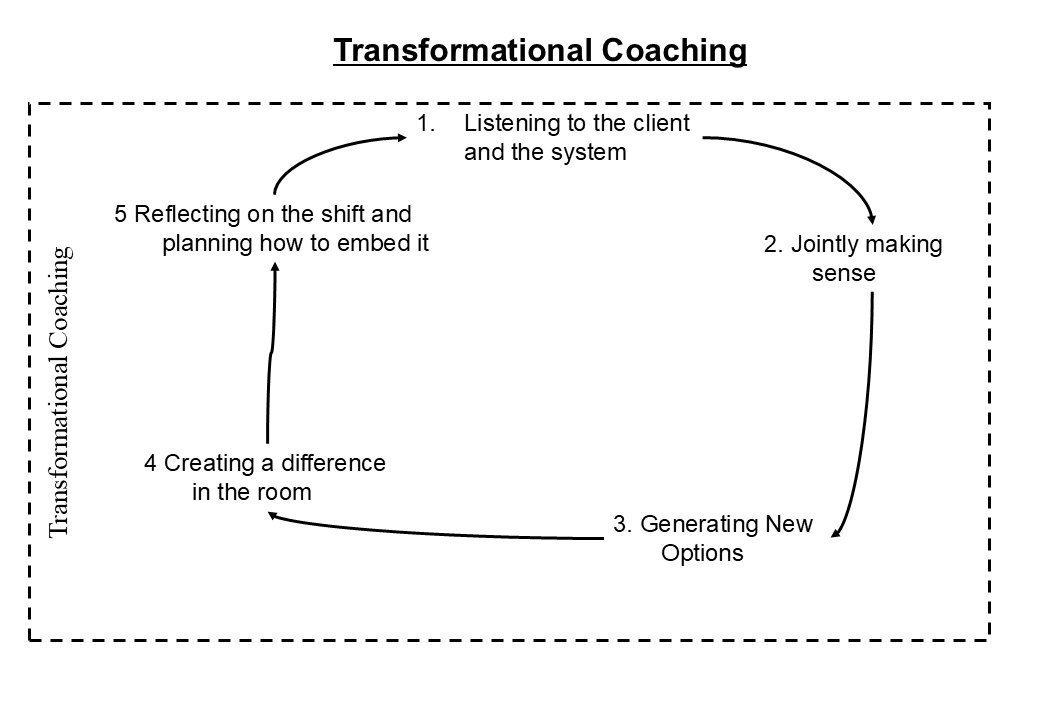
Diagram of coaching that brings the shifts into the room repeatedly
As the work progressed, there was a marked change in what leaders were willing to bring into the room. Complex dilemmas that would previously have been contained or hidden were now shared with the team. Isolation reduced. Leaders began to make fuller use of the diversity of expertise and perspective around the table.
The team realised they could shape and re‑shape strategy in action, rather than treating it as a fixed document. They also became more aware of how previous behaviours — often unintended — had caused pain, disconnection, or undermined their own intentions. For some individuals, these insights were genuinely revelatory and marked a turning point in how they understood their leadership impact.
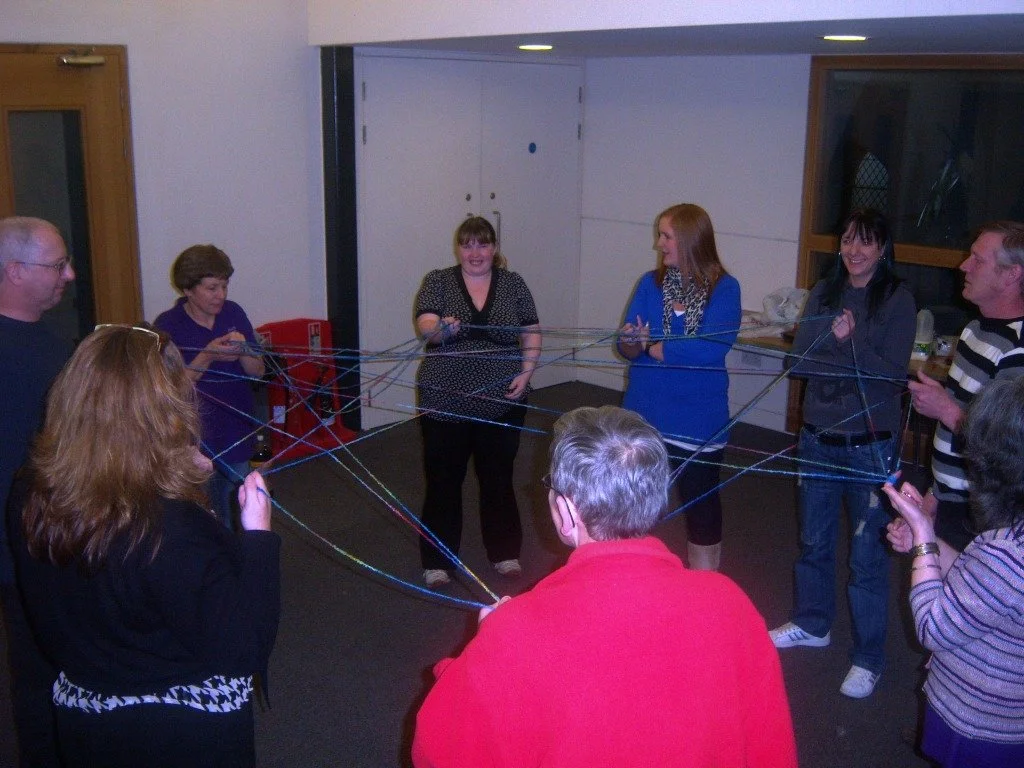
Example of team exercises I build in.
Trust increased in noticeable steps. With that trust came the surfacing of previously hidden conflicts and the need for more honest conversations. The team reorganised how their regular meetings worked, creating more focused agendas and a pace that was both responsive and deeper.
Beyond the room, leaders reported changes in how they led their own departments. Team meetings became more strategically integrated. New cross‑departmental collaborations emerged. Many leaders experimented with the same coaching approaches with their teams, supported by shared resources on change, transition, culture, and partnership working.
What did not change entirely were some of the more opaque power dynamics typical of large public institutions, where language and governance structures can still obscure influence. Naming this honestly was an important part of the work.
Why and how the executive team coaching led to systemic change.
At the time of the work, the institution was receiving national recognition for ambitious initiatives around cultural honesty and de‑colonisation. There was a real risk that internal strain, leadership fatigue, or loss of confidence could have diluted this work or slowed it to a safer, less challenging pace.
There were also fears among staff about cuts, instability, and whether the institution was running too far ahead of its peers. Without investment in leadership capability, the burden of carrying change risked falling disproportionately on a small number of people — particularly women and those closer to the work.
Strengthening the leadership team’s collective capacity helped protect both the ambition and the people required to sustain it.
Learning from this case study
Many senior leadership teams will recognise parts of themselves in this case, even if the context is different.
If you are leading an institution where the pace and ambition of change is accelerating, where ethical, cultural, and strategic demands are landing simultaneously, and where a small number of people seem to be carrying a disproportionate share of the emotional labour, then the question is not whether change is happening.
The question is whether your leadership culture is keeping up.
This case shows what becomes possible when a senior team invests in how it thinks and works together. It also offers a warning. When transformation is asked for without corresponding shifts in how authority and responsibility are exercised, people learn to mask change rather than embody it.
The invitation is to invest early in collective leadership capability, so that ambition is matched by practice, and integrity can be sustained under pressure.
Author’s note
This case reflects the kind of work I am increasingly choosing to focus on: deep, systemic listening with senior leadership teams facing ethical, cultural, and strategic complexity. Drawing on my Quaker roots and long experience of community life, I work by designing and holding process rather than content, trusting silence as much as speech. This allows leaders to slow down, think more honestly together, and act with greater integrity. It is the work that most stretches me, most satisfies me, and most supports institutions to lead real change without losing people, purpose, or trust.