What Holds Steady: Leadership, Faithfulness, and the Work of Accompaniment
Yesterday, sitting in a room of senior leaders, I became aware of something I could feel physically rather than simply observe intellectually.
Not a lack of intelligence. Not a lack of strategy.
But a kind of underlying instability — a constant shifting between priorities, pressures, and perspectives that made it difficult for anything to fully settle.
It showed up in the pace of conversation.
In how quickly agendas moved.
In the tension between wanting to influence and not quite having the space to think clearly about how.
What I realised, sitting there, was that without a clear inner and external compass, leadership in these times can begin to fragment.
There is, of course, a real and legitimate urgency.
Charities are working to influence policy, ensure voice, and help shape a better Scotland — particularly as things begin to settle again following the recent Holyrood election. There is energy, commitment, and a strong desire to contribute.
But there are also very real constraints.
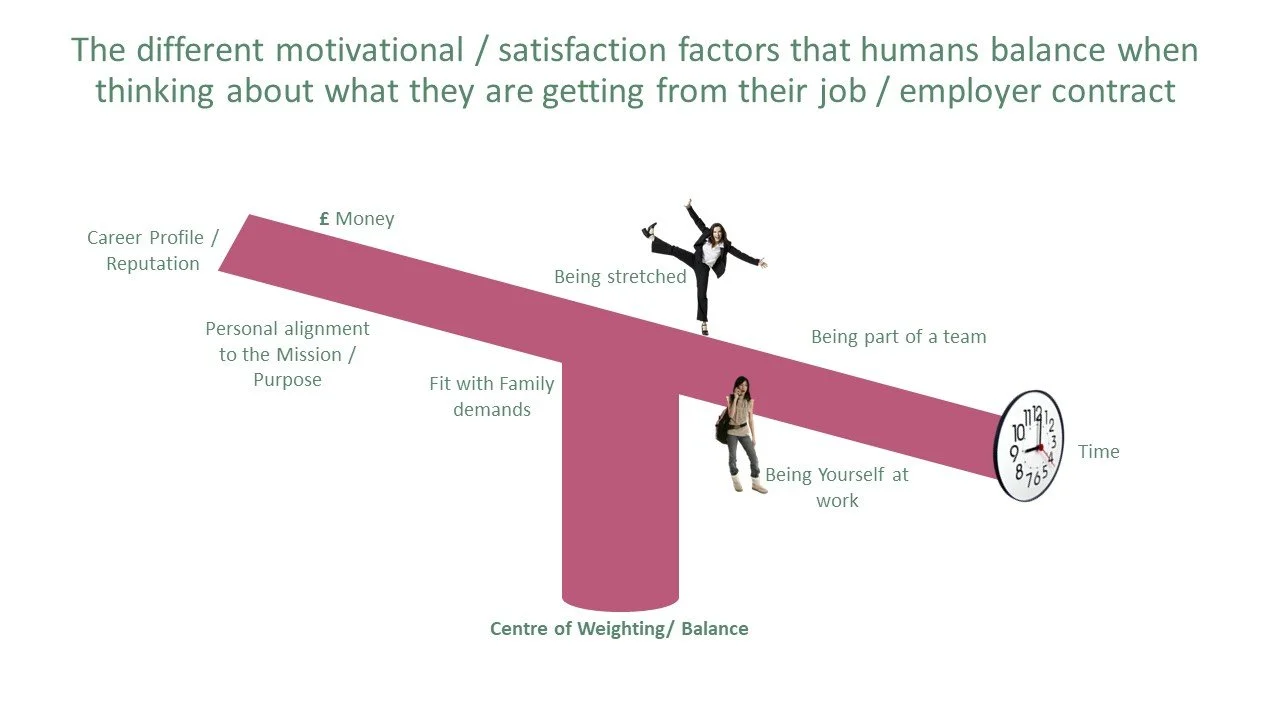
diagram for our social and financial contracts of employment
Leaders spoke openly about not having enough time.
About organisations that have been pinned back and trimmed over years of constrained resources.
About the constant pressure to respond, deliver, and engage — often simultaneously.
Under those conditions, fragmentation is not a failure of leadership.
It is an almost inevitable outcome of the environment.
And yet, as the day unfolded, something else began to happen.
As the group moved from early formation, through a degree of storming, into something more settled, there were moments where people began to reconnect — not just with the work, but with their own inner compasses.
Inner Compass work and North Star work.
Their reasons.
Their commitments.
Their sense of what actually matters.
That shift is subtle, but significant.
Because in complex times, leaders do not need more options.
They need something that holds steady.
That steadiness is not technical.
It is ethical.
For me, this is what I understand as faithfulness in professional life.
Not as a belief.
Not as a slogan.
But as the capacity to remain ethically oriented over time, even as pressures increase and clarity becomes harder to maintain.
What Holds Steady
It is, in essence, a form of continuity under pressure.
There was another aspect of the day that struck me more personally.
Because of my work regulating the Scottish Government, I carry a fairly detailed understanding of how public sector reform, legislation, and ministerial dynamics are likely to play out — including where the real points of influence sit.
What I noticed was this:
while many in the room were navigating uncertainty, I did not feel confused.
Not because the environment is simple — it clearly isn’t — but because I was working from a clear compass, both internal and external.
That clarity matters.
It doesn’t remove complexity, but it allows you to move through it without losing orientation.
Over time, I’ve come to understand that my work with organisations is shaped by this same principle.
Rather than offering a series of discrete consultancy services, I practice what I would call organisational accompaniment.
The Work of Accompaniment
This means walking alongside organisations as they navigate their strategic pathways — remaining present over time, and responding to what is needed as it arises.
In practice, that can take many forms:
coaching and advising Chief Executives, Chairs, and senior leaders;
designing and leading development processes, workshops and conferences;
undertaking evaluation, feasibility work, and partnership development;
supporting transitions, stabilising periods of change, or stepping into interim roles where needed.
Taken individually, these might look like separate services.
Taken together, they amount to something else entirely:
a consistent, reliable presence across change.
Clients do not need to continually shop around for different forms of support.
They know they can call — and that whatever is required, the work will remain grounded in the same ethical orientation.
One client described this, half in jest, as something like an Emmaus Walk for organisations. Not spiritual accompaniment, but corporate accompaniment — walking alongside as things are worked out, clarity emerges, and direction becomes possible again.
That description stayed with me.
Because at its best, this work is not about directing from the outside.
It is about staying alongside, asking the right questions, and keeping the path clear.
This is where ethics moves from principle into practice.
In line with professional standards such as the ICF Global Code of Ethics, the pathway must remain clear to the client at all times. That clarity is not achieved through rigid service definitions, but through consistency of intent and integrity of action.
The form may change.
The anchor does not.
Anchoring together.
As we look ahead, this matters more, not less.

Strategic Intent is like a small boat navigating an VUCA ocean - see sister article
We are operating in conditions of increasing volatility, uncertainty, complexity, and ambiguity — shaped not only by political cycles, but by the deeper impacts of climate change on economies, trade, and social systems over the coming decades.
In those conditions, leadership cannot rely solely on tools, frameworks, or speed of response.
Without a stable ethical compass, even the most capable leadership will begin to lose coherence.
With one, it becomes possible to navigate complexity without losing direction.
For me, that is what the symbol I carry represents.
A cross — structure and direction.
A circle — continuity and the cycles of the world.
A reminder that proportion matters, and that alignment is something to be held, not assumed.
But more importantly, it represents a commitment:
to remain steady
to remain clear
and to remain in the most practical, grounded sense of the word — to the work, to the people it serves, and to the wider world we are responsible for shaping.
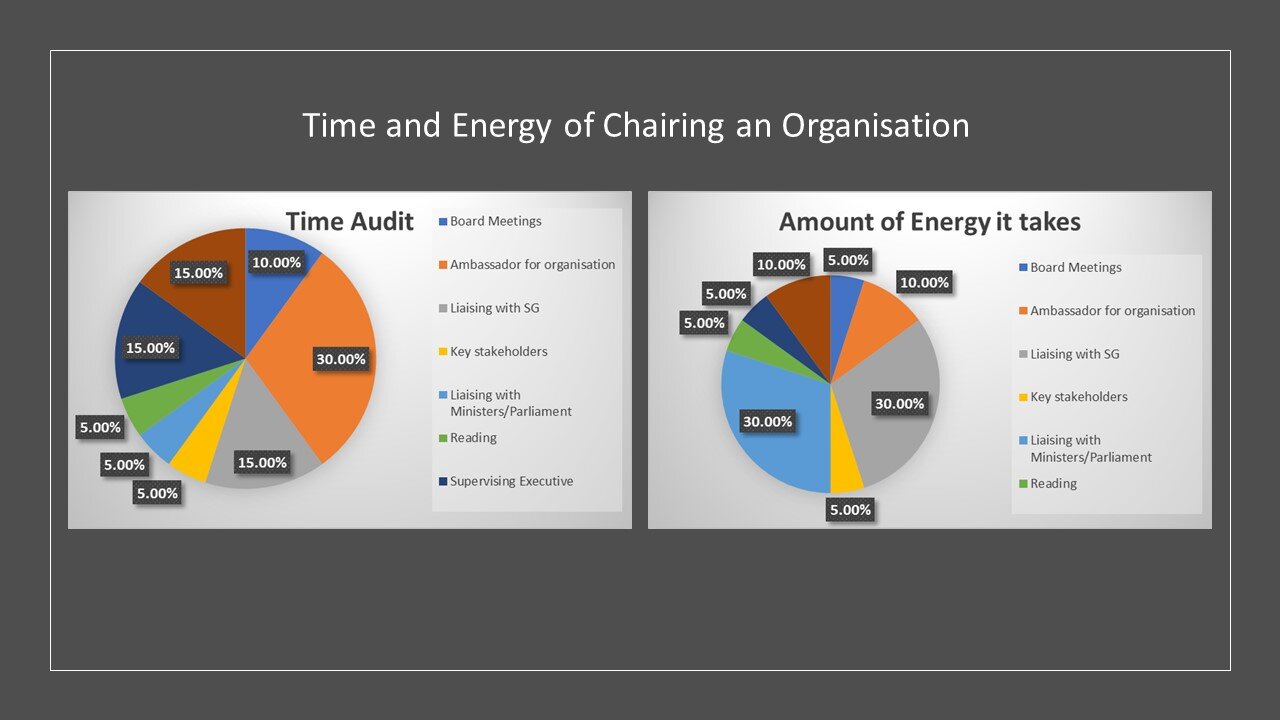
Alongside this, a recurring strand of my work is helping leaders and organisations re-balance their time and energy — not through productivity tools, but through clarity of focus.
Because under sustained pressure, it is often the important but not urgent work that is first to be squeezed out — the very work that restores direction, purpose, and role satisfaction.
Creating space for that is not an additional task.
It is part of the discipline of staying aligned.